
On 11-12 December 2025, the RIAS hosted an international conference on American-Dutch Connections in the Revolutionary Era. The conference brought together Dutch, American and French scholars to examine the current historiographical status of the political, commercial, cultural, and imperial connections between the Dutch Republic and the emerging United States during the Age of Revolutions.
The event was organized by Dirk Alkemade and Lauren Lauret of Leiden University, and Christine Mertens and Damian Pargas of the RIAS. It was part of the broader initiative “America2026,” a consortium that aims to reassess the European and North American historiographies of the American Revolution in light of the 250th anniversary of the American Revolution. America2026 is funded by the French Agence Nationale de la Recherche (ANR) and by the American Philosophical Center and the David Center for the Study of the American Revolution.
Day 1
The conference opened on Thursday with welcoming remarks by Damian Pargas, director of the RIAS, and Michelle McDonald, who highlighted the collaborations and initiatives that America2026 and the American Philosophical Society in Philadelphia.
The first panel, chaired by Bertrand Van Ruymbeke, Revolutionary Republicanisms, explored ideological exchanges across the Atlantic. Wyger Velema reflected on the historiographical trends within the study of classical republicanism, arguing that despite valid criticism, the classical paradigm, while Matthijs Tieleman situated American independence within the wider Patriot Atlantic, focusing on ideological connections before the radical shifts of the French Revolution.
The afternoon panel, chaired by Damian Pargas, shifted attention to economic entanglements. Victor Enthoven demonstrated the negative consequences the American Revolution eventually had for the Dutch Republic. Pauline Wittebol analyzed how the decision-making regarding the recognition of the United States by the States-General took place, nuancing the political role of John Adams in this process.
The day concluded with a keynote lecture by Nathan Perl-Rosenthal. In Revolutionary Afterlives Across the Atlantic, Perl-Rosenthal followed two lives into Atlantic and Pacific, using a “global micro-history” to connect multiple geographic, temporal scales that otherwise remain separate through individual life trajectories.
Day 2
Friday morning opened with a panel chaired by Jaap Jacobs on how imitation, perception, and historical memory connected the Dutch history and the American Revolution. Dirk Alkemade discussed American views of Dutch decline, arguing the Americans chose consciously not to use the “Dutch example” as a blueprint for their own revolution. Kieran O’Keefe, on the other hand, showed how the memory of the Dutch Revolt in the American Revolution was widely used by American revolutionaries and that this analogy was extremely versatile. Leila Tnainchi presented a visual history of Dutch-American revolutionary connections, examining graphic prints to explain shifts in American, Dutch, French and English relations in the Atlantic world.
The final panel, chaired by Brendan McConville, addressed slavery and colonialism. Papers by Andrea Mosterman and Michael Douma examined how the revolution impacted slavery in Dutch New York. Lauren Lauret looked adopted a long-term perspective and investigated how impressions of Dutch travellers in the US impacted Dutch colonial policies during the nineteenth-century.
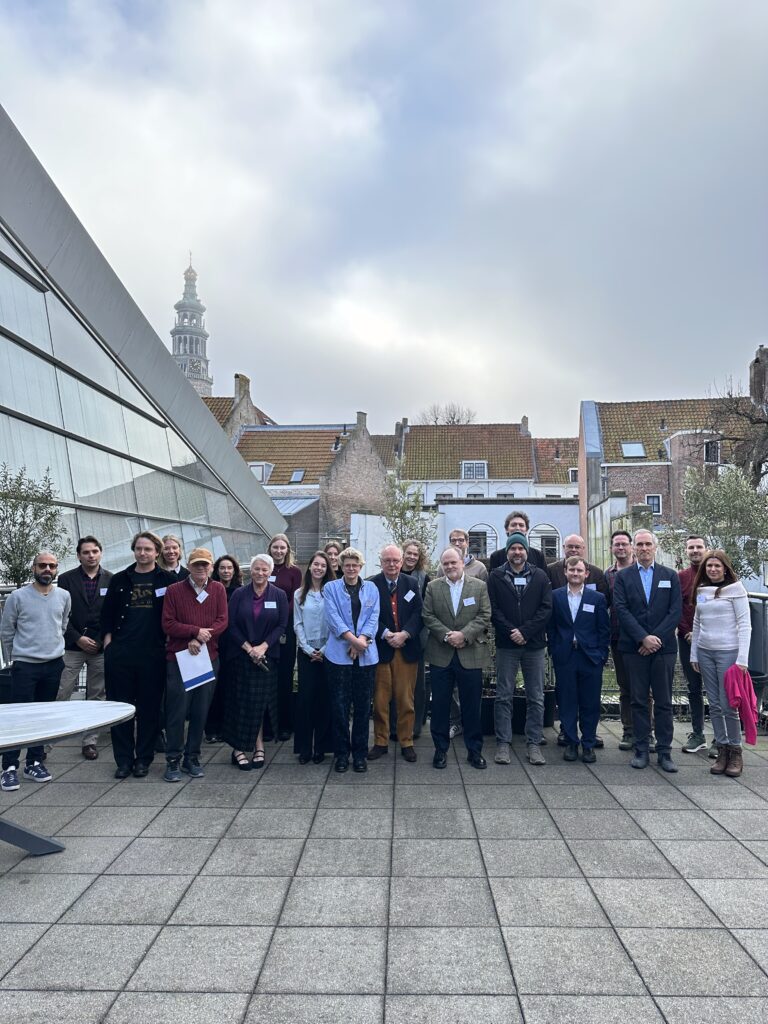
The conference concluded with a general discussion on the themes of the conference, chaired by Bertrand Van Ruymbeke, co-founder of America2026. Overall, the conference demonstrated the importance of situating the American Revolution within a broader Dutch and Atlantic and even Global framework, the importance of commercial and diplomatic networks and exchange of ideas and ideology that often preceded and outlasted the revolutionary age. The RIAS, America2026 and the organisers look back on a successful meeting and will explore opportunities to elaborate on the insights and results through further collaboration.
The RIAS thanks the speakers and attendees for their participation and insights, and looks forward to the next opportunity to have insightful conversations together.
The conference program can be found here.
Report by Dirk Alkemade
