
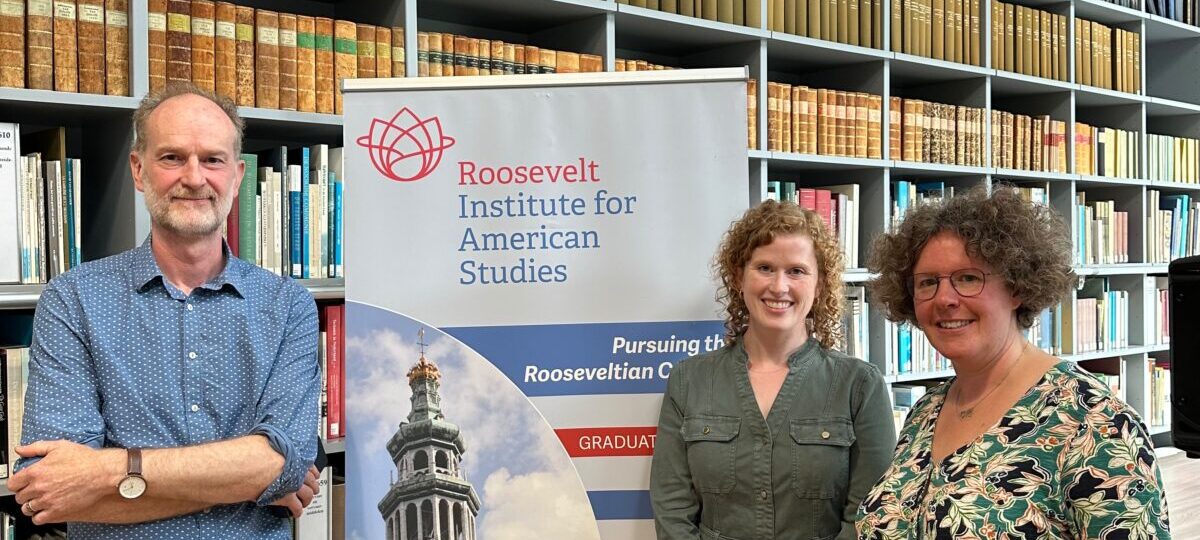
On Friday, 11 September 2026, Professor Giles Scott-Smith delivered the William J. vanden Heuvel Memorial Lecture, titled “Enduring Culture? US Cultural Diplomacy beyond Liberal Internationalism.”
The lecture honors William J. vanden Heuvel, the American diplomat and human rights lawyer who helped establish the RIAS in 1986. Held on the twenty-fifth anniversary of the September 11 attacks, this year’s event offered an opportunity to reflect on America’s changing relationship with the wider world.
Scott-Smith is Professor of Transnational Relations and New Diplomatic History at Leiden University and Dean of Leiden University College The Hague. He has longstanding ties to RIAS, having joined the Roosevelt Study Center in 2002 and served as academic director from 2017 to 2022. His recent volume, US Cultural Diplomacy after the Cold War: Decline, Recovery, and Fall?, co-edited with Jeffrey H. Michaels for Manchester University Press, examines US cultural diplomacy since 1991, including developments under the second Trump administration.
Drawing on this research, Scott-Smith traced the changing narratives and priorities of American cultural diplomacy. He began with its Cold War foundations, when the promotion of American freedom accompanied investment in alliances and international organizations, alongside a belief in progress. He then identified three phases after 1991: the “victory culture” of the 1990s; the Global War on Terror between 2001 and 2013, when the September 11 attacks brought renewed funding and a stronger emphasis on security and strategic communication; and a period without an overarching narrative from 2014 onward. Across these phases, cultural diplomacy continued to emphasize international connections and the vitality and diversity of American culture.
The lecture then examined the relationship between cultural diplomacy and culture war under the second Trump administration. Scott-Smith considered political intervention in cultural and educational programs alongside changes in the administration’s approach to Europe and its presentation of American identity abroad. These developments raised questions about the future of cultural diplomacy as US foreign policy moved away from the commitments to multilateral cooperation associated with liberal internationalism.
Following the lecture, Laurien Crump (Radboud University) and Kaete O’Connell (Southern Methodist University) offered responses. Crump emphasized the link between security and cultural outreach, noting how security imperatives can shape the priorities and purposes of cultural diplomacy. O’Connell highlighted the importance of continuity in cultural outreach, including the persistence of smaller-scale programs, amid strained transatlantic relations and pressure on domestic cultural institutions.
The event placed current debates about US cultural diplomacy in a longer history of how America has sought to build relationships and exercise influence abroad.
We thank the speakers for their insights and the audience for their questions and contributions to the discussion.
You can find the invitation here.
