
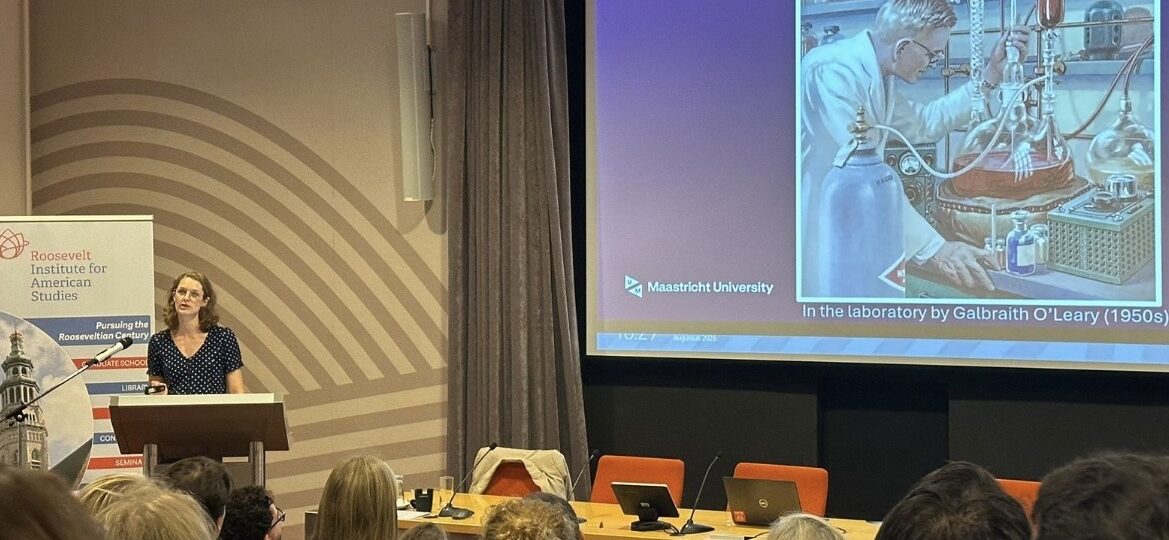
On Wednesday 26 August 2026, Dr. Simone Schleper (Maastricht University) presented this year’s RIAS Environmental History Lecture, “Global Environmental Governance from Elsewhere.”
In her lecture, Schleper challenged the tendency to locate global environmental governance primarily in intergovernmental conferences and other formal arenas. Drawing on the history of science, which has shown how knowledge is also made in homes, field sites, and personal relationships, she proposed treating governance as a practice and aspiration – something actors imagined, contested, and pursued. Following governance into private settings, she argued, revealed both informal networks and people who appear only marginally in official records.
Schleper developed this argument through the private networks of Canadian businessman and UN environmental official Maurice Strong and his second wife, Hanne Marstrand Strong. Their gatherings in private homes, holiday retreats, and remote field settings connected UN officials, business leaders, bankers, development experts, environmentalists, and countercultural and spiritual thinkers. These “elsewheres” were not separate from formal institutions. They helped generate ideas later advanced through official forums, while giving corporate and financial actors access to environmental policymaking from an early stage.
Her central case was Crestone, Colorado, where the Strongs began developing a model community in the late 1970s. Hanne Marstrand Strong played the leading role in its daily development, coordinating land donations and bringing together organizations such as the Lindisfarne Association, the Aspen Institute, Buddhist and Carmelite communities, and advocates of solar energy and ecological design. Crestone became a meeting place for corporate, technological, ecological, and spiritual approaches to planetary governance. Although the proposed solar village remained unfinished and the wider project nearly unraveled, Schleper showed that its importance lay in the networks and ideas it fostered rather than in its success as a settlement.
Schleper described the vision emerging from these networks as “economic humanism”: a model that combined faith in corporate and technological action with commitments to social equity and environmental stewardship. The outlook’s institutional and technological elements informed Strong’s work with the Brundtland Commission and were later reflected in Agenda 21 at the 1992 Rio Conference. Yet the model contained a central tension. As Schleper put it, it offered the Global South “the right to develop differently, but not equally,” because it did not confront the redistribution of resources and power. Its flexible view of environmental limits allowed corporate partners to embrace technological solutions and business-friendly sustainability without sharing the Strongs’ ethical commitments. Schleper concluded that this history helps explain how business interests became embedded in UN environmental politics and how ecological limits were reframed as flexible through technology, consumer choices, and corporate behavior.
The lecture was held in the auditorium of the Provinciehuis before an engaged audience. The Q&A prompted a discussion of the composition, motivations, and objectives of the informal networks at the center of Schleper’s research.
See the official invitation here.
