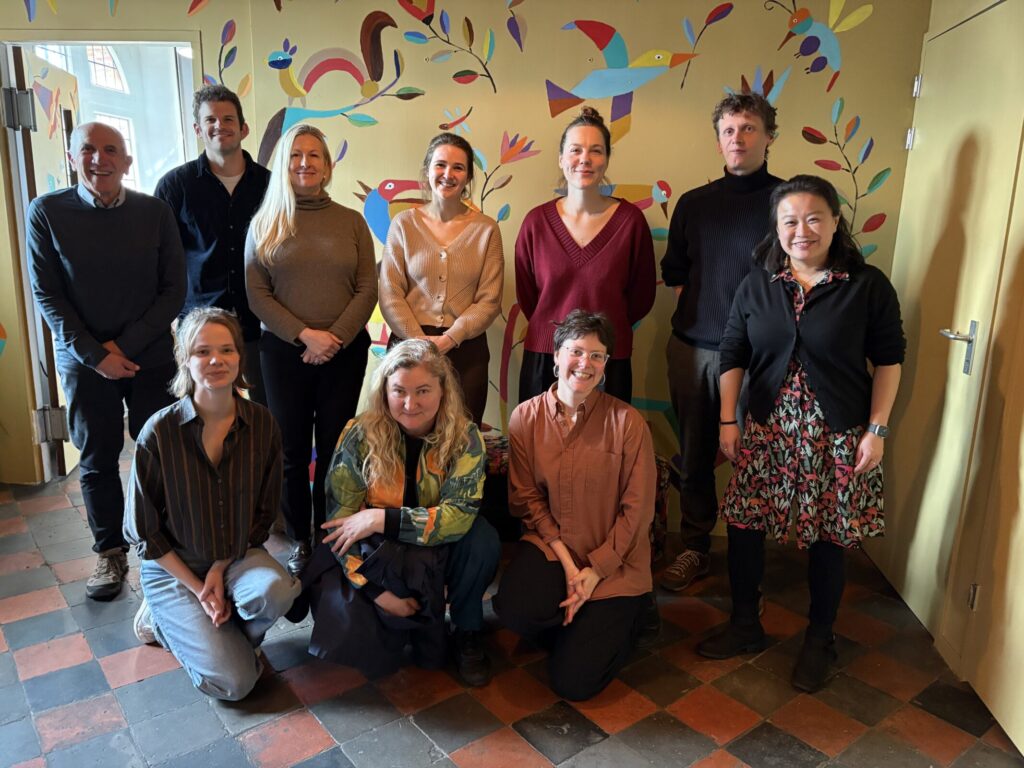

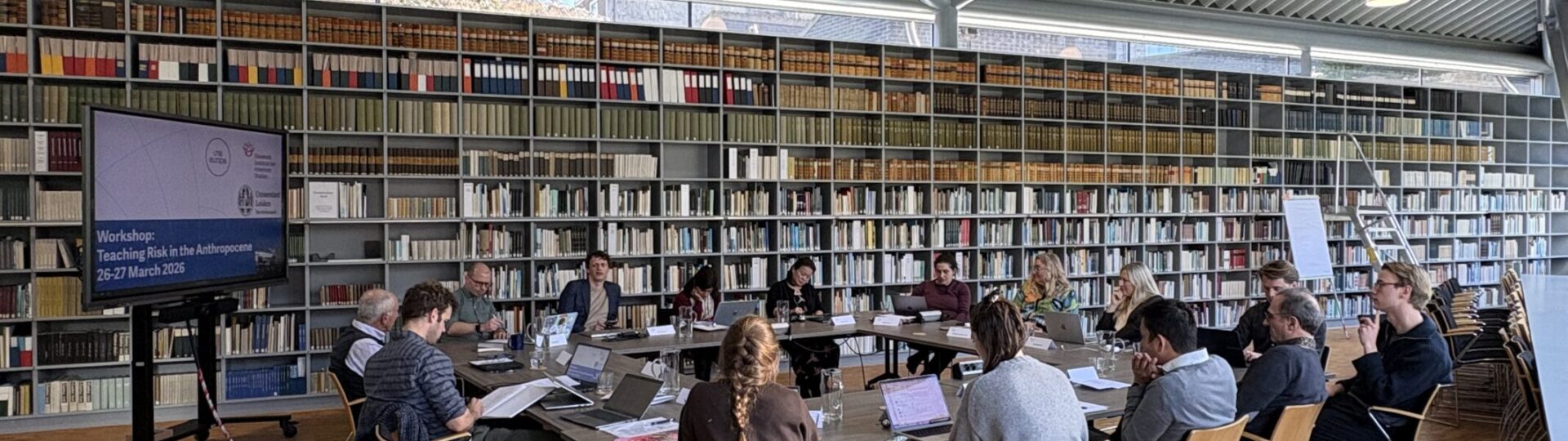
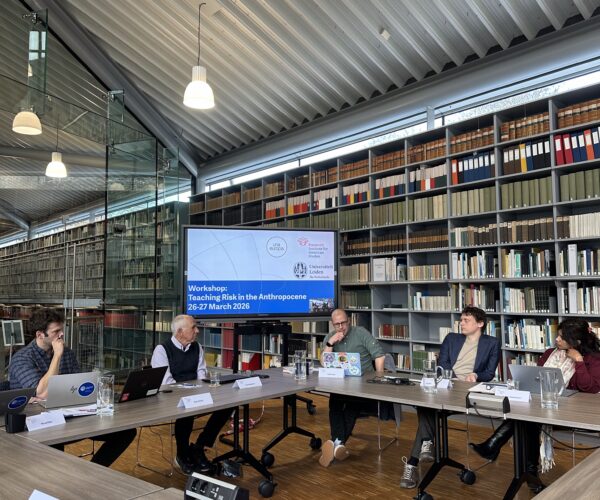
On 26 and 27 March 2026, the RIAS hosted a workshop, funded by Una Europa, titled “Teaching Existential Risk in the Anthropocene.” It brought together scholars from a variety of European universities and several disciplines to develop a syllabus on existential risks in the Anthropocene at the bachelor’s level.
Existential Risk is by now a much used, though contested, concept used to explain and study several of the most pertinent and difficult to predict threats facing humanity in today’s world of climate crisis, continued nuclear threats, and AI. With academic institutions like the Cambridge Center for the Study of Existential Risk (CSER) and public-facing institutions like the Existential Risk Observatory in Amsterdam beginning to tackle the issue in the last decade, the growing field of Existential Risk studies is a crucial one for bachelor students from all backgrounds to become familiar with. During the two days of this workshop, experts from fields like International Relations, mathematics, history, geography, veterinary sciences, environmental law, and public-facing institutions discussed what an interdisciplinary bachelor’s course on this topic could and should look like.
The first session allowed participants to introduce themselves, their expertise, and the way they define existential risk within their own research and teachings. The second session concerned the establishment of learning objectives and discussions around syllabus design. The final session revolved around the pedagogy of teaching this existential risk; how do you engage students in a topic that is inherently uncertain and unsettling? The discussions were insightful, stimulating, and productive. The breadth of perspectives made it clear how challenging but also important it is be to create a truly interdisciplinary course on this topic in this age of intersecting global vulnerabilities which cut across borders and require input from all disciplines to mitigate and prevent.
We thank everyone who participated and look forward to seeing these discussions put into practice when the syllabus is piloted in the coming years.
This workshop was attended by Vanessa Burns (Cambridge Center for the Study of Existential Risk), Stella Mazeri (University of Edinburgh), Daniel Linders (KU Leuven), Franck Lavigne (Université Paris 1 Panthéon-Sorbonne), Katarzyna Jasikowska (Jagiellonian University in Kraków), Joanne Yao (Queen Mary University of London), Pauline Heinrichs (King’s College London), Otto Barten (Existential Risk Observatory), Eva Seuntjes (International Institute for Social History), Kritika Maheshwari (TU Delft), Benoit Pelopidas (Sciences Po), Mark Squillace (University of Colorado), Ylva Axelsson (Leiden University), Thomas Brinkman (Leiden University), Kenzo Eulink (University of Amsterdam/RIAS), and Dario Fazzi (Leiden University/RIAS).
This event was organized by Maud Rijks (Leiden University) and Rob Cullum (Leiden University).
See the program here.