


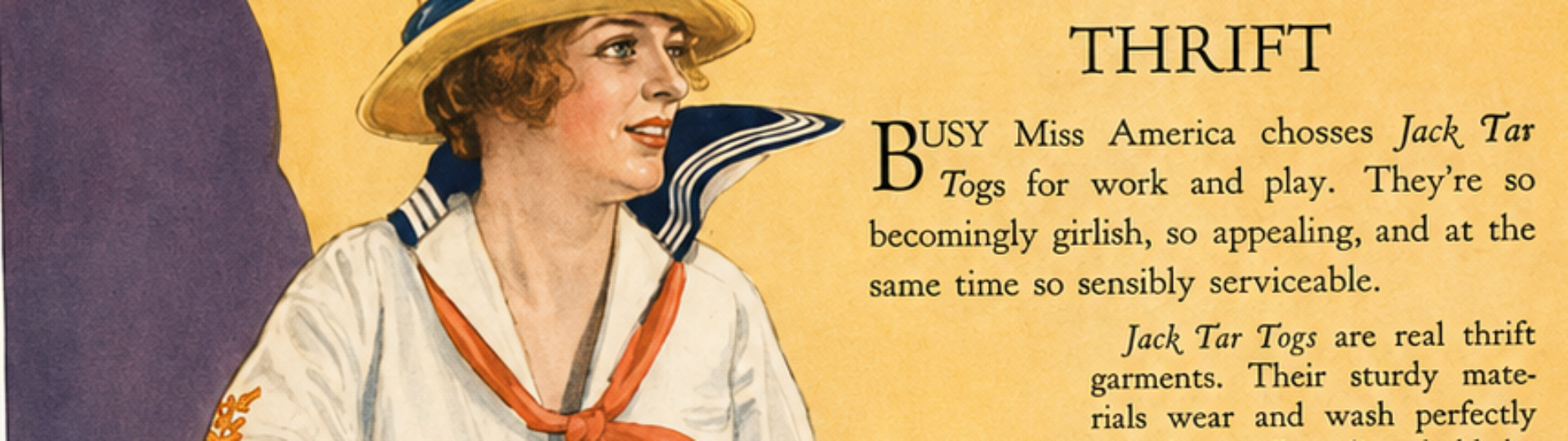
The meaning of “modern woman” has never been a single, stable idea but has been constantly defined and redefined in everyday life. In the early twentieth century, this shifting idea took shape in everyday objects and practices – new technologies, consumer goods, fashion, advertising, work, leisure, and changing expectations about what women could do, want, and become.
In popular magazines such as the Ladies’ Home Journal, “modernity” often took shape in various depictions of women, sometimes rooted in the routines of the home, sometimes moving through spaces of leisure and public activity.
Alongside changing ideas of women’s roles, the late nineteenth and early twentieth centuries saw rapid economic growth and rising purchasing power in the American middle class. More Americans could now spend their money on leisure and consumer goods. Magazines benefited directly from this shift by offering news, fiction, advice, and advertising in a single format and becoming a key channel for consumer culture in middle-class homes. Women’s magazines like the Ladies’ Home Journal addressed their female readers as both homemakers and consumers, shaping how women spent both their time and money.
Under Edward Bok’s long editorship (1890–1919), the journal became a “helping” magazine for women, offering guidance on household management and modern consumption in an appealing format aimed at a broad white middle-class readership. It formed a commercial space that celebrated women’s differences from men while reinforcing traditional roles and expectations. By the late 1910s, however, these roles and expectations were being challenged through wartime labor, suffrage activism, and shifting domestic expectations. Women did not leave the domestic sphere, but the expectations attached to it were changing.
These shifts were visible in Bok’s own pages. Previously, his editorials and magazine content reflected his opposition to women’s suffrage and continued to frame the home as women’s primary sphere. Yet by the end of the decade, as women’s public presence grew, the journal increasingly acknowledged changing domestic roles and included articles on women earning their own money and entering paid workforces.
The magazine also expanded its advertising. By the end of the 1910s, it carried more advertisements and service content, reflecting the rise in consumerism. The advertisements themselves were not necessarily meant to state a clear ideology. Their purpose was to market products, not to participate in social debates. Yet through their descriptions and depictions of women, they nonetheless conveyed contradictory and ambiguous messages about women’s roles. This ambiguity in advertising is evident in Volume 36 of the Ladies’ Home Journal (1919). This issue, along with many others, is fully accessible at the RIAS.
Ingenious and efficient inside the home
Images of women performing domestic duties remained the most common in the Journal, but the language of advertisements reveals subtle shifts in how women were addressed.
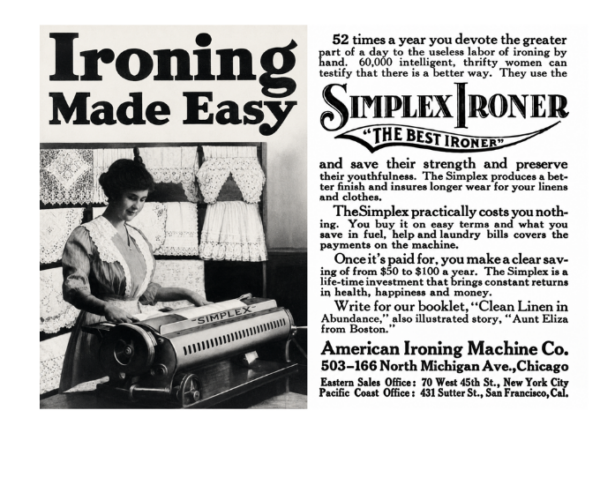
Ads often appealed to women through flattery. An advertisement for the new Simplex Ironer addressed “intelligent, thrifty women,” presenting the reader as a discerning, modern consumer whose purchase would demonstrate good judgment. The iron was promoted as a way to save women’s strength and preserve their youthfulness, implicitly acknowledging the physical toll of housework while offering greater efficiency.
A similar emphasis on efficiency appeared in a November advertisement for a new stove, marketed as the ideal Christmas gift. It promised to “save steps for her” and reduce the wife’s daily burden by limiting trips between the dining room and kitchen. The new Sani-Flush toilet cleaner promised to make the task you used to dread simple and easy: “It cleans the closet-bowl and does it without any drudgery in your part.”
These advertisements did not suggest that women should perform less domestic work. Rather, they encouraged women, as intelligent consumers, to purchase products that would complete household tasks more quickly and efficiently. The emphasis on saving money, time, and effort might suggest that women had more worthwhile ways to spend these resources, which could be interpreted as a move towards modernity. However, the underlying expectation was that domestic responsibilities remained her primary concern.
Active and comfortable outside the home
A smaller group of advertisements pointed in the opposite direction. Rather than selling modernity to women within the home, they advertised for activities outside of the domestic sphere.
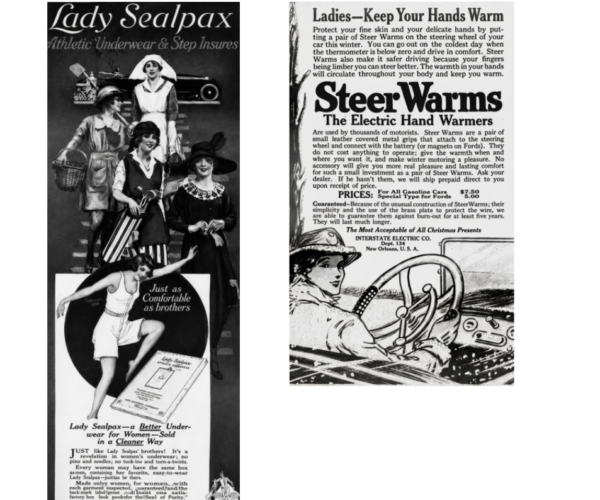
Lady Sealpax promoted athletic underwear with the promise of “freedom of action,” claiming that women could enjoy “the same luxurious comfort her brother enjoys.” The advertisement depicted women outside the home, presenting them as active participants in professional and leisure pursuits rather than solely in domestic roles. The promise of efficiency is also again evident in this advertisement, which highlights its “serviceable” design by eliminating the need for safety pins.
Similarly, a Steer Warms advertisement in the November edition showed a woman driving a car, highlighting the increased mobility available to women. However, the advertisement still stressed that the electric hand warmers would protect her “delicate hands” while driving in winter, combining images of “modern’” female independence with more traditional ideas about femininity.
These advertisements suggest that representations of women were beginning to expand beyond the domestic sphere. Women were increasingly depicted as workers, consumers, athletes, and drivers, reflecting social changes associated with modernity. However, the framing remained recognizably traditional as even images of independence and mobility were still accompanied by emphasis on women’s “delicate” femininity and their continued association with comfort and practicality.
Conclusion
These advertisements do not present a single, coherent image of the “modern woman,” but instead reveal a moment in transition. Within the Ladies’ Home Journal, women were simultaneously addressed as smart. efficient managers of the household and as increasingly visible participants in public. Yet even these outward-facing depictions rarely fully broke with convention, as notions of femininity remained tied to comfort, delicacy, and refinement. In this way, the Journal reflects a broader cultural uncertainty. Modern womanhood was being imagined and marketed, but not yet firmly defined.
Resources at the RIAS:
- Primary sources:
Ladies’ Home Journal, vol. 36 (1919) Microfilm Reel 21.
- Secondary literature:
Damon-Moore, Helen., Magazines For The Millions: Gender and Commerce in the Ladies’ Home Journal and the Saturday Evening Post, 1880-1910. (State University of New York Press, 1994).
Feldmann, Martha Johnson., Never underestimate empowerment through consumption: omen and the “Ladies Home Journal” from the 1880’s. (UMI 1992).
Krabbendam, Hans. The Model Man: A Life of Edward William Bok, 1863-1930. (BRILL 2022).
Scanlon, Jennifer., Inarticulate Longings: The Ladies’ Home Journal, Gender, and the Promises of Consumer Culture. (Psychology Press, 1995).
Other secondary literature:
Rabinovitch-Fox, Einav, ‘New Women in Early 20th-Century America,’ Oxford Academic (22 Aug. 2017).
